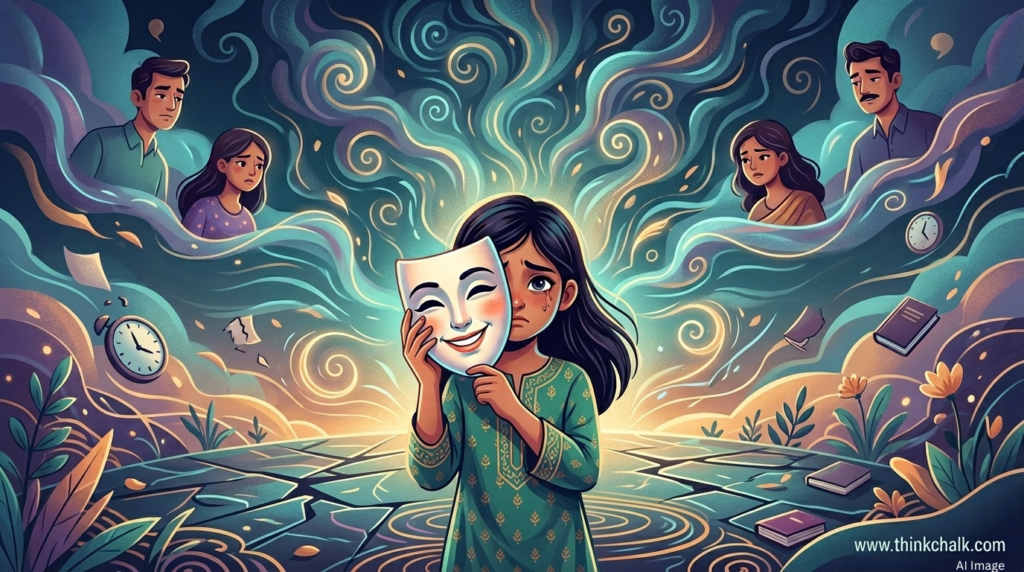
What a 2016 American film reveals about the quiet crisis that Pakistani parents are trained not to see.
I was watching The Edge of Seventeen one evening, a 2016 American coming-of-age film that had been sitting in my watchlist far longer than I care to admit. About twenty minutes in, something clicked. Not in the way a good film entertains you. In the way a good film makes you sit up and think about someone you have not thought about in months.
I found myself thinking about a girl I had worked with two years ago. I will call her Aisha.
Aisha was seventeen, in her final year of school, and predicted strong grades. Her teachers described her as hardworking. Her parents used the words parents always use for teenagers who are not obviously struggling: “woh theek hai” (she is fine). She participated in class. She submitted her assignments on time. She smiled when she smiled at.
She was also falling apart, quietly, in a way that none of the adults around her had any language for including her.
By the time the film ended, I understood exactly why it had clicked.
What The Film Actually Shows
The film’s protagonist, Nadine, is seventeen. She is not failing at school. She is not in obvious trouble. She is sarcastic, self-aware, and funny, which, as many parents discover too late, is a highly effective cover.
What Nadine cannot do, what the entire film quietly circles around, is name what she is feeling. She knows she is miserable. She does not know why. She cannot explain it to the one teacher she trusts, cannot explain it to her mother, cannot explain it to herself. She experiences her emotions as a flood that keeps arriving without warning and retreating without resolution.
A word of context before going further: The Edge of Seventeen earns its rating for frank language and some mature themes. I would not recommend it for younger teenagers. But for parents of older teens, it is one of the most psychologically precise portrayals of adolescent distress I have seen. Not the loud kind. The invisible kind.
The film opens with Nadine telling her teacher plainly, and without melodrama, that she is considering ending her life. It is a moment that lands with the weight it deserves: not as shock, not as spectacle, but as the simple, devastating consequence of a teenager who has run out of other ways to be heard. What it reveals is not Nadine’s crisis alone. It reveals the failure of every adult around her to notice, over months and years, that she was struggling. She had been sending signals. Nobody had the tools to read them.
That gap between what a teenager feels and what the adults around them can see is the real subject of the film. And it is also, I would argue, one of the most pressing conversations we are not having in Pakistani homes.
The Gap Between Performance and Feeling
There is a framework I return to often when thinking about teenagers like Aisha and Nadine. It comes from the Yale Centre for Emotional Intelligence, where researcher Marc Brackett developed RULER, an approach to emotional intelligence built on five skills: Recognising, Understanding, Labelling, Expressing, and Regulating emotions.
RULER is not a therapeutic tool. It is a developmental one. Its premise is simple but important: emotional intelligence is not something children are born with. It is learned, and it can only be learned if the adults around them model it, name it, and create space for it.
What Nadine in the film lacks and what many Pakistani teenagers I have worked with also lack is not courage or self-awareness. It is vocabulary. The ability to say: “I feel this specific thing,” and to tell you what it is, and to believe you will not dismiss me for saying it.
Without recognising and Labeling, emotional experience stays locked inside. Without expressing, it builds pressure. Without adults who model Regulation, teenagers have no map for what to do when the pressure becomes unbearable.
The film shows, over and over, what happens in that absence.
What Pakistani Homes Add to This Picture
The Edge of Seventeen is an American story. But the dynamic it captures is not.
A 2025 analysis in The Friday Times, citing a UNICEF assessment, reports that one in four Pakistani adolescents experiences symptoms of anxiety or depression. A small fraction ever receives professional help. In Pakistani homes, as a 2025 analysis in The Friday Times observed, mental distress is frequently misread or dismissed as laziness, as dramatic thinking, as a failure of faith. Depression becomes “zyada soch leti hai” (she overthinks). Anxiety becomes “natak hai” (she is being dramatic). The conversation closes before it begins.
This is not a failure of love. Pakistani parents love their children fiercely. It is a failure of language, specifically, the emotional language that lets a parent read what a child cannot yet say.
There is also something particular about daughters. The cultural expectation of composure, of managing one’s emotions quietly, of not burdening the family, falls differently on teenage girls than on boys. A crying daughter is noticed. A daughter who is functioning, performing well, being polite, and staying out of trouble is assumed to be fine. The smile is read as a report.
What makes The Edge of Seventeen so unsettling is exactly this: Nadine looks fine. She sounds fine. She is performing fine. And no one around her, until it is almost too late, thinks to ask what fine is actually covering.
What Parents Can Do
I want to be careful not to turn this into a checklist. Aisha’s story did not need a checklist. It needed one adult willing to sit through discomfort.
But if I were to offer parents something concrete, it would start with language.
Begin noticing, in your own conversations, how emotions are talked about at home. Not whether they are allowed, most Pakistani homes are not hostile to emotion, but whether they are named. Is sadness called sadness, or is it called weakness? Is anxiety acknowledged, or is it reframed as a problem to be solved or ignored?
Your teenager is watching how you handle your own emotional states. If you regulate by suppressing by pushing through, by insisting everything is fine, she is learning to do the same.
The second thing I would offer is the quality of your questions. “How was school?” is a closed door. “What was the hardest part of your day?” is an opening. “Is there anything you have been sitting with lately that you haven’t known how to bring up?” is an invitation.
It takes more time. It requires you to be willing to hear something you were not expecting. But it is exactly the kind of conversation that Nadine in the film was desperate for and never quite got, until a teacher finally asked the right question, at almost the last possible moment.
I have watched many films about teenagers. Most of them are about the ones who act out the rebellion you can see, the crisis that announces itself. The Edge of Seventeen is about the other kind. The ones who are quietly, competently, invisibly not fine.
I thought about Aisha for a long time after the credits rolled. Not because her story ended badly, it didn’t. But because I kept wondering how close it came, and how much depended on one adult eventually asking the right question at the right moment.
“Woh theek lagti hai” (She seems fine.) In Pakistani parenting, those three words carry enormous weight. They end conversations. They close doors. They allow the adults in the room to feel relieved and move on.
The question worth sitting with the one the film left me with is this: what might we hear if we stopped taking “fine” at face value, and asked, gently, what was actually going on underneath?
If you are concerned about a young person’s mental health and are not sure where to start, Umang Pakistan’s first 24/7 mental health helpline, run by clinical psychologists and registered with WHO, is a place to reach out. You do not need to be in crisis to call.
excellent piece of writing and this must be discussed in parent teacher meeting
I could’nt agree more,the irony is,these instances are still happening.