Tag: parenting tips

“She Seems Fine” The Most Dangerous Phrase in Pakistani Parenting

What a 2016 American film reveals about the quiet crisis that Pakistani parents are trained not to see.

I was watching The Edge of Seventeen one evening, a 2016 American coming-of-age film that had been sitting in my watchlist far longer than I care to admit. About twenty minutes in, something clicked. Not in the way a good film entertains you. In the way a good film makes you sit up and think about someone you have not thought about in months.

I found myself thinking about a girl I had worked with two years ago. I will call her Aisha.

Aisha was seventeen, in her final year of school, and predicted strong grades. Her teachers described her as hardworking. Her parents used the words parents always use for teenagers who are not obviously struggling: “woh theek hai” (she is fine). She participated in class. She submitted her assignments on time. She smiled when she smiled at.

She was also falling apart, quietly, in a way that none of the adults around her had any language for including her.

By the time the film ended, I understood exactly why it had clicked.

Continue reading ““She Seems Fine” The Most Dangerous Phrase in Pakistani Parenting”


The Loneliest Generation: Why Pakistani Teenagers Feel Alone in a Connected World

Being seen online is not the same as being known at home.

I remember sitting in a parent workshop in Karachi last year when a father raised his hand and said something I have not been able to forget.

“Sir, mera beta ghar mein rehte hue bhi ghar mein nahin hota.” (“Sir, my son lives in our home, but he is never really there.”)

He wasn’t talking about physical absence. His son was in the next room, phone in hand, surrounded by voices from a screen. The father hadn’t lost him to rebellion or bad company. He had lost him to something quieter. A distance with no name. A kind of presence that isn’t really there.

His son has hundreds of followers. He posts. He scrolls. He replies. But when was the last time anyone, including the people who love him most, asked him something real?

He has 847 followers. He came home from school today and didn’t speak to a single person he trusts. That’s not a connection. That’s performance.

Continue reading “The Loneliest Generation: Why Pakistani Teenagers Feel Alone in a Connected World”

Is Your Teenager Dating an AI?

When emotional connection moves from home to a chatbot, what are we really missing at home?

A few weeks ago, a parent came to me after my class. She was not panicking. She was confused.

“Sir, mene mere bete ka phone check kiya toh usne kisi se ghanton baat ki thi. Phir pata chala… koi insaan hi nahin tha.” (Sir, I checked my son’s phone and saw he had been talking to someone for hours. Then I found out… it wasn’t a person at all.)

Her son, seventeen, O-Levels, quiet at home, had been spending two to three hours every evening in deep conversation with an AI chatbot. Not for homework. Not for any school project. He was sharing how lonely he felt. How he felt misunderstood. How he wished someone at home would ask him something other than “padhai kaisi chal rahi hai?” (How is your studying going?)

The chatbot had been listening.

Continue reading “Is Your Teenager Dating an AI?”

Young Lives, Heavy Pressure: Listening to What Our Students Are Carrying

Trigger warning: this post discusses suicide and self-harm. If you or someone you know is in immediate danger, contact local emergency services or a mental health helpline immediately. In Pakistan, national helplines and crisis support services are available to offer confidential support.

In recent months, we have seen a painful pattern repeating itself across Punjab: university students, bright, young people who should be building futures, are taking desperate steps or attempting to take their lives. These are not isolated tragedies; they are a mirror reflecting pressures that many families do not see clearly until it is too late. Recent reporting from Lahore and elsewhere has linked some of these incidents to academic pressure, failed relationships, and family conflicts, and universities and families alike are asking hard questions about what went wrong. (The Express Tribune, AAJ TV)

As a parent, it is natural to react with shock and guilt: ‘Kiya mein jaan sakta tha? Kiya mein pehlay qadam utha sakta tha? (Could I have known? Could I have acted sooner?) Those are painful but familiar questions. We also need to step back and look more critically at the systems surrounding our children, at what we ask of them, what schools expect, and how families respond when a child shows signs of pain. This is not about assigning blame to any single person. It’s about noticing patterns and changing them.

Continue reading “Young Lives, Heavy Pressure: Listening to What Our Students Are Carrying”

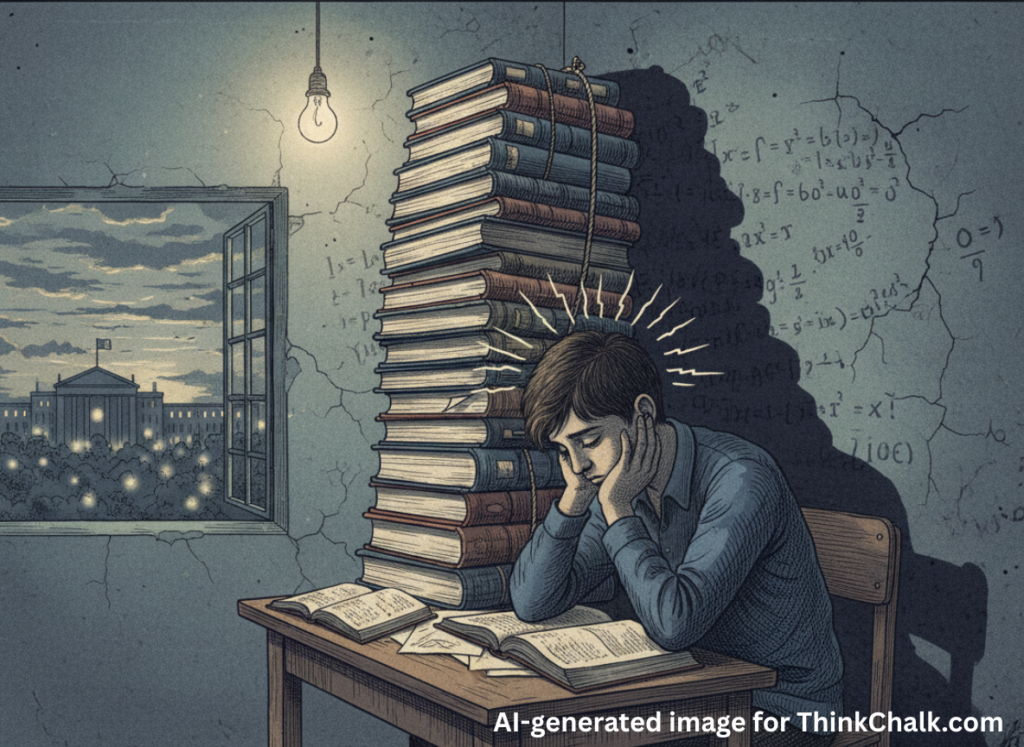
Teen Academic Burnout: A Growing Crisis We Can No Longer Ignore

I’ve been thinking a lot about the quiet exhaustion I often notice in teenagers today, the way their shoulders slump under the invisible weight of expectations, or how their eyes lose a little of their spark as exams approach. Sometimes, when I’m mentoring students or talking to parents, I find myself asking: When did learning become so heavy for our children?

In Pakistan, where grades are tied to prestige, opportunity, and sometimes even family honour, academic pressure doesn’t just sit in school bags; it follows students into their homes, their sleep, and their identities. And whether we admit it or not, teen academic burnout has slowly become a national concern.

What Exactly Is Teen Academic Burnout?

Academic burnout is more than just being “tired of studying.” Psychologists describe it as a state of emotional, mental, and physical exhaustion caused by long-term academic stress (Schaufeli et al., 2002).

Continue reading “Teen Academic Burnout: A Growing Crisis We Can No Longer Ignore”

Nomophobia: Understanding the Rising Digital Addiction Among Students

How parents and teachers can help children balance their digital lives

Have you ever seen your teen panic when their phone battery dies or when there’s no Wi-Fi signal? Recently, I came across a research article on ResearchGate that introduced me to the term “Nomophobia.” To my surprise, it perfectly described a growing issue I often observe among students: an emotional dependence on their mobile phones. Among high school and college students, what’s the one thing they can’t seem to live without? You guessed it, their mobile phones. In fact, research shows that many adolescents would rather lose a pinky finger than their cell phone! This bizarre attachment has led to a growing number of students who prefer texting or tweeting instead of face-to-face conversations.

This irrational fear of being without a mobile phone is called Nomophobia, a short form for “no-mobile-phone phobia.” It’s the fear of being disconnected, whether because of a low battery, no signal, or simply leaving the phone behind.

Continue reading “Nomophobia: Understanding the Rising Digital Addiction Among Students”