
Tag: Teen Mental Health

“She Seems Fine” The Most Dangerous Phrase in Pakistani Parenting

What a 2016 American film reveals about the quiet crisis that Pakistani parents are trained not to see.

I was watching The Edge of Seventeen one evening, a 2016 American coming-of-age film that had been sitting in my watchlist far longer than I care to admit. About twenty minutes in, something clicked. Not in the way a good film entertains you. In the way a good film makes you sit up and think about someone you have not thought about in months.

I found myself thinking about a girl I had worked with two years ago. I will call her Aisha.

Aisha was seventeen, in her final year of school, and predicted strong grades. Her teachers described her as hardworking. Her parents used the words parents always use for teenagers who are not obviously struggling: “woh theek hai” (she is fine). She participated in class. She submitted her assignments on time. She smiled when she smiled at.

She was also falling apart, quietly, in a way that none of the adults around her had any language for including her.

By the time the film ended, I understood exactly why it had clicked.

Continue reading ““She Seems Fine” The Most Dangerous Phrase in Pakistani Parenting”

The Loneliest Generation: Why Pakistani Teenagers Feel Alone in a Connected World

Being seen online is not the same as being known at home.

I remember sitting in a parent workshop in Karachi last year when a father raised his hand and said something I have not been able to forget.

“Sir, mera beta ghar mein rehte hue bhi ghar mein nahin hota.” (“Sir, my son lives in our home, but he is never really there.”)

He wasn’t talking about physical absence. His son was in the next room, phone in hand, surrounded by voices from a screen. The father hadn’t lost him to rebellion or bad company. He had lost him to something quieter. A distance with no name. A kind of presence that isn’t really there.

His son has hundreds of followers. He posts. He scrolls. He replies. But when was the last time anyone, including the people who love him most, asked him something real?

He has 847 followers. He came home from school today and didn’t speak to a single person he trusts. That’s not a connection. That’s performance.

Continue reading “The Loneliest Generation: Why Pakistani Teenagers Feel Alone in a Connected World”

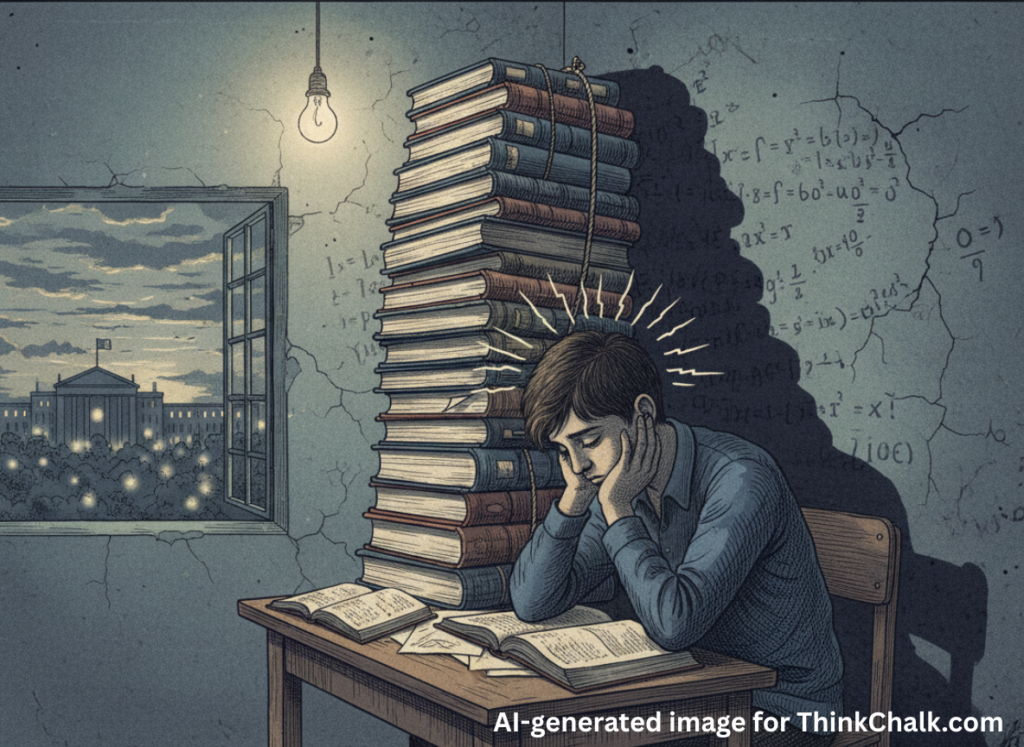
Young Lives, Heavy Pressure: Listening to What Our Students Are Carrying

Trigger warning: this post discusses suicide and self-harm. If you or someone you know is in immediate danger, contact local emergency services or a mental health helpline immediately. In Pakistan, national helplines and crisis support services are available to offer confidential support.

In recent months, we have seen a painful pattern repeating itself across Punjab: university students, bright, young people who should be building futures, are taking desperate steps or attempting to take their lives. These are not isolated tragedies; they are a mirror reflecting pressures that many families do not see clearly until it is too late. Recent reporting from Lahore and elsewhere has linked some of these incidents to academic pressure, failed relationships, and family conflicts, and universities and families alike are asking hard questions about what went wrong. (The Express Tribune, AAJ TV)

As a parent, it is natural to react with shock and guilt: ‘Kiya mein jaan sakta tha? Kiya mein pehlay qadam utha sakta tha? (Could I have known? Could I have acted sooner?) Those are painful but familiar questions. We also need to step back and look more critically at the systems surrounding our children, at what we ask of them, what schools expect, and how families respond when a child shows signs of pain. This is not about assigning blame to any single person. It’s about noticing patterns and changing them.

Continue reading “Young Lives, Heavy Pressure: Listening to What Our Students Are Carrying”

Helping Teens Breathe: Supporting Adolescent Mental and Emotional Well-Being

I often find myself pausing at the school gates, watching groups of teenagers walk in, some laughing, some silent, some with headphones plugged in, all carrying invisible loads on their shoulders. As an educator and parent, I can’t help but wonder: What kind of world are they growing up in?

It’s a world that expects them to excel, to fit in, to stand out, and to do all of that gracefully, all before they even understand who they truly are.

In writing this reflection, I wanted to look beyond test scores and report cards, and into the hearts of adolescents navigating their mental and emotional worlds. Whether in the busy school corridors of Karachi or the diverse classrooms of London, many young people share the same quiet struggle balancing their dreams with the weight of expectations.

Continue reading “Helping Teens Breathe: Supporting Adolescent Mental and Emotional Well-Being”

Nomophobia: Understanding the Rising Digital Addiction Among Students

How parents and teachers can help children balance their digital lives

Have you ever seen your teen panic when their phone battery dies or when there’s no Wi-Fi signal? Recently, I came across a research article on ResearchGate that introduced me to the term “Nomophobia.” To my surprise, it perfectly described a growing issue I often observe among students: an emotional dependence on their mobile phones. Among high school and college students, what’s the one thing they can’t seem to live without? You guessed it, their mobile phones. In fact, research shows that many adolescents would rather lose a pinky finger than their cell phone! This bizarre attachment has led to a growing number of students who prefer texting or tweeting instead of face-to-face conversations.

This irrational fear of being without a mobile phone is called Nomophobia, a short form for “no-mobile-phone phobia.” It’s the fear of being disconnected, whether because of a low battery, no signal, or simply leaving the phone behind.

Continue reading “Nomophobia: Understanding the Rising Digital Addiction Among Students”

How Childhood Trauma Shapes Adult Life and What Parents Can Do to Help

Earlier today, I met one of my childhood friends after many years. As we laughed and reminisced about the mischievous adventures of our childhood gang, I was filled with warmth and nostalgia. Yet, amid this joy, a thought struck me that not all childhood memories bring happiness. For some, childhood is not a time of laughter and play, but of pain and fear.

A few weeks ago, during an educational camp I was conducting in the central region of Pakistan, a 19-year-old student shared his childhood experiences with me. His story reminded me how deeply early trauma can shape a person’s adult life. Childhood abuse, whether physical, sexual, or emotional, or even neglect by parents, can leave lasting scars. Children who are hurt by the very people they trust and love most often grow up feeling betrayed, wounded, and unworthy. If these emotional wounds remain unhealed, they silently seep into adulthood, affecting one’s self-image, relationships, and capacity to trust.

Continue reading “How Childhood Trauma Shapes Adult Life and What Parents Can Do to Help”

Why Family Involvement Matters for Teens

Last week, I sat down to watch The Blind Side again, the 2009 Hollywood film starring Sandra Bullock and Quinton Aaron. Though I’d seen it before, this time it struck me differently. Perhaps because, as a teacher and mentor working closely with teenagers, I’ve come to recognise just how fragile the teenage years can be and how much difference a caring family or even one caring adult can make.

The movie tells the true story of Michael Oher, who grew up facing poverty, neglect, and homelessness before becoming a star in the NFL. While it’s framed as a sports drama, I saw it less as a football story and more as a lesson on the importance of family involvement. As I watched Michael’s life unfold on screen, I couldn’t stop asking myself: What does family really mean for a teenager’s growth and development?

Continue reading “Why Family Involvement Matters for Teens”