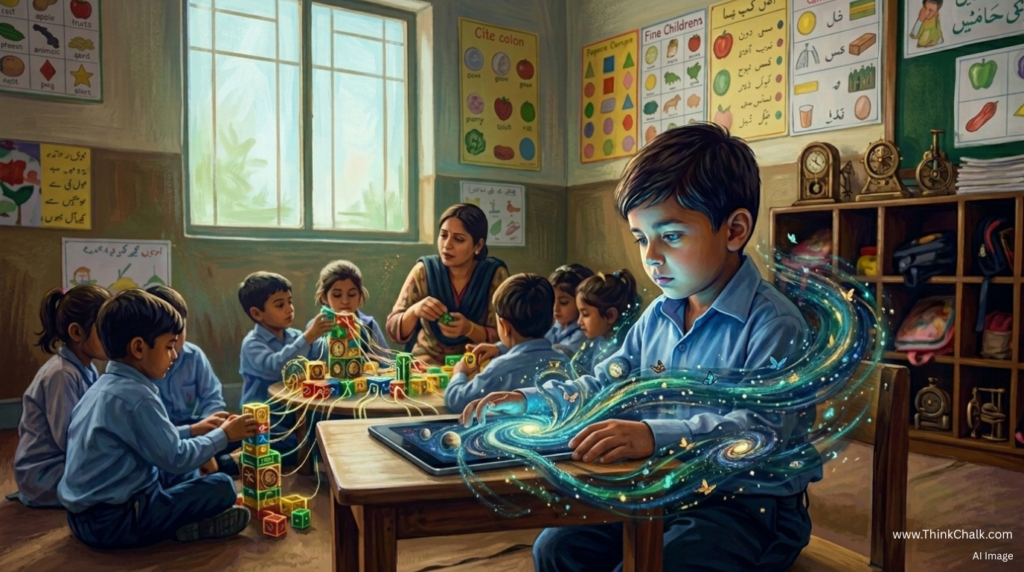
What the conversation around “virtual autism” is telling Pakistani parents, educators, and early childhood classrooms and why we are only beginning to listen.
There was a boy sitting in the corridor outside a parent workshop I was running last year. He must have been three, maybe three and a half. His mother was inside the session. He was with a domestic helper, parked on a plastic chair, a tablet propped in his lap.
He did not look up when I walked past. He did not look up when another child came and stood near him. He did not look up at all, for the entire two hours I was facilitating. He was not upset. He was not restless. He was perfectly, completely still.
On the way out, his mother mentioned almost as an aside that his nursery teacher had suggested he be assessed. He was not talking much. He did not play with the other children. He preferred to be alone.
“Woh bus khaamosh hai,” (He is just quiet,) she said. “Humein lagta tha yeh uski aadat hai.” (We thought it was just his nature.)
I have been thinking about that boy ever since.
A Term Worth Understanding Honestly
You may have come across the phrase “virtual autism” recently in a parenting group, in a school newsletter, or in a WhatsApp forward, with varying degrees of alarm. Before we go further, it is worth being precise about what the term actually means.
“Virtual autism” is not a clinical diagnosis. It does not appear in the DSM-5 or ICD-11, the standard manuals doctors use to diagnose conditions. The term was coined in 2018 by a Romanian psychologist, Marius Zamfir, to describe a specific pattern he was observing: “young children between zero and three years old who were showing autism-like symptoms reduced eye contact, delayed speech, social withdrawal, sensory sensitivities that appeared to be linked to excessive screen exposure, and that improved significantly when screen time was reduced and face-to-face interaction was increased.”
The research that has followed is early but consistent in its direction. A 2024 study at UC Davis Medical Centre’s MIND Institute found that toddlers with developmental delays who had high screen exposure at 18 months were significantly more likely to show autism and ADHD-like symptoms than those with lower screen exposure. A large Japanese study tracking over 84,000 children found that longer screen time at one year of age was significantly associated with autism spectrum disorder symptoms at age three.
What makes this pattern different from autism as we understand it neurologically is reversibility. Children showing virtual autism symptoms have, in documented cases, shown meaningful improvement when screen time stopped and real human interaction, warm, responsive, and back-and-forth, was restored. That is an important distinction. And it is also, as we will see, where Pakistani families and classrooms have a real role to play.
What Pakistani Homes Are Quietly Producing
Here is the part of this conversation that I find most important and most under-discussed.
In urban Pakistani homes, the screen-as-babysitter is not a failure of parenting. It is, in many cases, a survival strategy. Both parents are working. The domestic helper is managing three things at once. The joint family system that once meant a grandmother or khala (Aunt) was always nearby has, in many urban households in Karachi, quietly dissolved. The child needs to be safe, contained, and occupied. The tablet delivers all three, instantly, without complaint.
A study published in the Pakistan Journal of Medical Sciences found that preschool children in Islamabad exposed to more than 60 minutes of daily screen time showed significantly higher rates of withdrawn behaviour and autism spectrum-like symptoms compared to children within the recommended limit. The recommended limit, set by the American Academy of Paediatrics, is zero screen time for children under 18 months and no more than 1 hour per day for children aged 2 to 5. Most parents I speak with in workshops estimate their child’s daily exposure at well above that, often between two and four hours, sometimes more.
Researchers from the Aga Khan University, reviewing the impact of screen time on children under five in Pakistan, found that excessive exposure was consistently linked to delays in language development, reduced social-emotional responsiveness, and impaired ability to regulate emotions, precisely the cluster of difficulties that virtual autism describes.
This is not a problem unique to a single income bracket or a single type of home. It is showing up in nurseries and play groups across urban Pakistan, and teachers often notice it before parents do.
What Educators Are Seeing and What They Need
For teachers in early childhood settings, this is already a classroom reality. Children are arriving in nursery and Montessori programs less verbal than a generation ago, less able to make eye contact with peers, and more comfortable in parallel solitude than in collaborative play. Many teachers describe the same thing: the child who sits quietly, does not initiate, does not respond to social cues, and does not seem to know what to do when another child approaches.
The instinct is often to label this as shyness, introversion, or “just the way he is.” And sometimes, that is accurate. But for early childhood educators, particularly those trained within frameworks such as those at AKU-IED, which centres on holistic child development and the importance of responsive, relationship-based learning environments, the distinction matters. A child who has developed socially withdrawn patterns through excessive screen exposure in the critical zero-to-three window is not the same as a child with a neurodevelopmental condition. The pathway back is different. And it starts with the quality of human interaction that the classroom offers.
What this means practically for educators: the early childhood classroom is not just a space for learning shapes and colours. For some of these children, it may be one of the few spaces in their day where genuine back-and-forth human interaction happens, where someone looks at them, waits for a response, and responds in return. That is not incidental to the curriculum. For a child showing early signs of social withdrawal, it may be the most important part.
What Parents Can Actually Do
I want to be careful here, because the guilt spiral is not useful and it is not the point.
If you are reading this as a parent, the question is not whether you have made mistakes every parent has, in a thousand ways, and most of them do not leave lasting damage. The question is what you can change, starting now, with the time and resources you actually have.
The research on reversibility offers genuine hope. Children showing virtual autism-like symptoms have demonstrated meaningful developmental recovery when screen exposure was reduced and face-to-face interaction was responsive, warm, and patient. The brain in early childhood is still forming. The window for positive change, while not unlimited, is real.
A few starting points that are practical rather than aspirational:
- The first is narration. When you are with your young child, cooking, folding laundry, getting ready, and talking. Not in the way of instruction, but in the way of commentary. “Dekho, mummy saalan bana rahi hai.” (Look, Mummy is making the curry.) The child does not need to respond. They need to hear language that is alive, addressed to them, and connected to a real face and a real moment.
- The second is looking. Eye contact, maintained warmly and without pressure, is one of the primary ways a young child’s social brain learns to calibrate. Put the phone down for ten minutes and just play messily, without purpose, following whatever the child initiates.
- The third is patience with silence. If your child is slow to respond, slow to speak, or slow to make eye contact, the instinct is to fill the gap. Resist it. Wait. The wait itself is a kind of invitation.
And if you are genuinely concerned that nursery teachers have flagged something, if you have noticed a pattern that does not feel like ordinary quietness, please speak to a developmental paediatrician rather than a WhatsApp forward. Early assessment, where indicated, is not a verdict. It is information. And information is what makes change possible.
I think about that boy in the corridor often. I think about his mother’s phrase “humein lagta tha yeh uski aadat hai” (we thought it was just his nature) and how much weight a small assumption can carry. How long can it postpone a question that was always worth asking?
The conversation around virtual autism is still young, and the science is still developing. But the pattern it points to, that the quality of a child’s earliest human interactions shapes everything that follows, and that screens, however useful, cannot substitute for those interactions, is not new at all. It is something developmental psychology has been saying for decades.
The question worth sitting with, whether you are a parent, a teacher, or someone who works with young families, is this: in the life of the youngest children around us, how much of what they are experiencing as interaction is actually human and how much has quietly been outsourced to a screen?