Pakistani schools are full of young people who already know how to show up for each other. We just haven’t trained them yet.
I was observing a mentee’s class last term, one of those routine observation visits where you sit quietly at the back with a notepad and try not to distract anyone. The lesson was moving along well enough. But what caught my attention had nothing to do with the teaching.
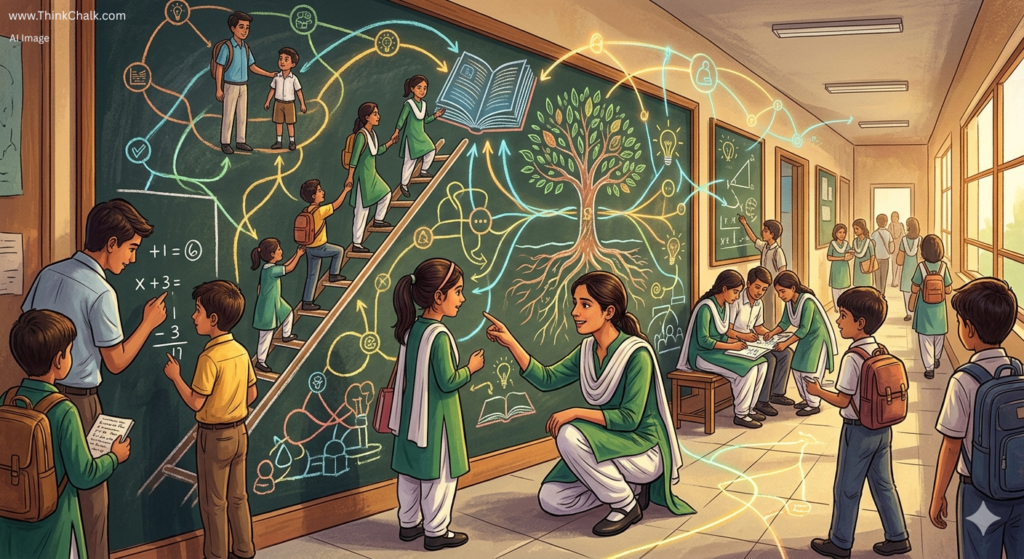
In the third row, a Grade 10 student had quietly shifted her chair a few inches closer to the girl beside her, a Grade 8 student who had recently transferred from another school and still carried that particular kind of stillness that new students wear when they are not yet sure where they belong. Without a word, the older girl slid her open notebook across. Pointed to something. The younger one nodded. A small moment. Thirty seconds, at most.
But I stopped writing my observation notes entirely.
Nobody had arranged that exchange. Nobody had trained the older student to do it. And yet something genuinely useful had just happened, something a teacher standing at the front of the room could not have engineered, no matter how skilled.
That is the thing about peer support. It finds its own way in. The question is what happens when we decide to take it seriously.
The Research Is Quiet but Consistent
Peer mentorship in schools, structured programs where older students are trained to guide younger ones, has been building a quiet case for itself in adolescent development research for over a decade. The outcomes are hard to ignore.
Teenagers in structured peer mentoring programs are significantly more likely to graduate on time, show measurably improved self-esteem, stronger social skills, and reduced symptoms of depression and anxiety. One reason these outcomes are so consistent is what researchers call the embarrassment barrier, the fact that a substantial portion of adolescents, studies suggest roughly 35%, will not seek help from an adult when they are struggling, but will open up to a peer who is just a few years older and remembers what the transition felt like.
This is not simply a Western finding. A 2024 review published in Frontiers in Public Health examining peer support interventions across South and Southeast Asia found consistent improvements in young people’s wellbeing and sense of belonging, particularly during school transitions. The evidence points in one direction: when it works well, peer mentorship is among the most cost-effective, youth-accessible support structures a school can build.
And yet. Most Pakistani schools have not built it.
Why Pakistan’s School Culture Makes This Hard
Pakistan’s school culture is built on hierarchy and not always the gentle, mentoring kind. Older students are not cultivated as guides or co-educators. They are simply further ahead in the exam queue. The idea that a 17-year-old could meaningfully support a 14-year-old through social anxiety, a difficult class transition, or the disorientation of being the new student is not something most school structures have ever considered, let alone planned for.
There are cultural dynamics at play, too. In many Pakistani schools, cross-grade socialisation is quietly discouraged. Seniority carries weight, but not warmth it is expressed through authority, not accompaniment. “Baray log barabar nahin bolte” (elders do not speak as equals) is not a written rule in any school handbook, but it shapes the corridors.
This is not unique to Pakistan; hierarchical school cultures exist across South Asia, but the consequences are real. When young people have no structured peer pathway to reach for help, they either find informal, untrained support (like the girl in my mentee’s classroom), rely entirely on overstretched teachers and counsellors, or they reach for nothing at all.
Mentoring Is a Skill, not a Personality Trait
Here is where Carol Dweck’s Growth Mindset framework becomes useful not just for students struggling academically, but for how we think about mentorship itself.
A fixed mindset tells us that some teenagers are natural leaders and some are not, and that only the naturally confident ones can guide others. This is how most schools unconsciously select prefects and monitors: by picking the loudest voices or the highest scorers. A growth mindset asks a different question: what if mentoring is a skill that can be taught? What if empathy, active listening, and knowing when to refer a friend to a counsellor are capacities that develop with training, practice, and reflection?
The research supports this reframe. Studies consistently show that peer mentors who receive structured training, even a brief orientation on listening skills, boundary-setting, and recognising distress, are significantly more effective than untrained peers and report higher self-esteem and leadership confidence. The mentoring relationship grows both people. The Grade 10 student learns as much from guiding a Grade 8 classmate as the younger student does from being guided.
This is why structured peer mentorship is not just a welfare program for struggling students. It is a leadership development opportunity for the mentors themselves, a fact that makes it easier to advocate for in school systems focused on outcomes and employability.
What Schools and Parents Can Do
If you are an educator reading this, the starting point is simple: you do not need a large budget or a new curriculum to begin.
Name and train what already exists. Informal peer support is already happening in most schools in corridors, in WhatsApp groups, between siblings and cousins in different grades. The first step is to recognise it, and then offer the students doing it some basic skills: how to listen without fixing, when to involve an adult, and how to take care of themselves in the process.
Start with school transitions. The move from middle to secondary, or from one school to another, is one of the most documented moments of adolescent vulnerability. A structured peer-welcome system, even one in which an older student is matched with two or three incoming students for a term, is a low-cost, high-impact starting point.
Involve parents early. Pakistani parents, understandably, may worry that peer influence is negative. Framing peer mentorship as a structured, school-supervised program with trained student mentors, clear boundaries, and teacher oversight directly addresses this concern.
A Closing Thought
That girl in my mentee’s classroom did not need a certificate or a training manual to be a source of quiet steadiness for a younger student. But she would have been more effective, more confident, and better protected from emotional overload if someone had given her the tools to do it well.
Pakistani schools are full of those girls. Or that boy. Young people who already know how to show up for each other just need someone to notice and then invest.
What would change in your school if the students who already help each other informally were trained, recognised, and trusted to do it with intention?