
What happens to a teenager’s identity when no one, not even their technology, ever disagrees with them?
I was running a session with a group of sixteen and seventeen-year-olds at a Karachi school last term. We were talking about AI, how it works, how they use it, and what they tell it. At some point, almost without thinking, I asked a question I hadn’t planned.
“How many of you have ever disagreed with your AI? Like, actually pushed back on something it said?”
Silence. A few uncertain looks around the room. Then, slowly, one hand.
“Sir, maine ek baar try kiya tha, but it just agreed with me anyway.” (Sir, I tried it once, but it just agreed with me anyway.)
The room laughed. I laughed too. But on the drive home, the less funny it seemed.
What Adolescence Actually Needs
There is a concept in developmental psychology that I come back to often, one that has been sitting in research literature since the 1950s, but feels startlingly relevant right now.
Erik Erikson, the psychologist who first mapped how human identity develops across a lifetime, described adolescence as the stage where a young person must wrestle with who they are, and the wrestling itself is the point. Identity, he argued, does not emerge from a mirror. It emerges from collision: with a parent’s different opinion, a teacher’s challenge, a friend who sees the world differently.
The friction is not the problem. The friction is the process.
AI chatbots, the kind teenagers are now turning to for hours at a time, are designed to do exactly the opposite. They are optimised for engagement, and, in practice, engagement means agreement. They validate. They affirm. They reflect back whatever the teenager brings with warmth, with apparent understanding, and with zero resistance.
That is not a neutral feature. It is a developmental concern.
A New Kind of Echo Chamber
We have spoken a lot about echo chambers in the context of social media, how algorithms serve up content that confirms what we already believe. But the AI echo chamber is something different, and I think something deeper.
A social media algorithm feeds you content you agree with. An AI companion talks back in a voice that feels personal, that responds to your confusion, your loneliness, your late-night thoughts. It feels like a relationship. For many teenagers, it is functioning like one.
DataReportal’s Digital 2025 Pakistan report tells us that Pakistan now has over 66.9 million social media user identities, with the fastest-growing group being young people aged 15 to 24. These are not passive consumers. They are young people forming beliefs, testing values, and figuring out who they are, increasingly in digital environments built to keep them comfortable.
When AI enters that space as a companion rather than a tool, something shifts. The young person is no longer just consuming content that agrees with them. They are having conversations that align with their beliefs. Every thought they share is met with understanding. Every belief they express is received with warmth.
This is what I mean when I say: she is growing up inside a mirror.
The Ecology of Identity and What Is Quietly Missing
The developmental psychologist Urie Bronfenbrenner gave us a useful way to think about this. His ecological systems theory describes identity as something that forms through layered relationships: family, school, peers, and community, each exerting its own particular kind of pressure on the young person at the centre. The theory’s core insight is not complicated: you become who you are through the people around you, and specifically through the friction those relationships carry.
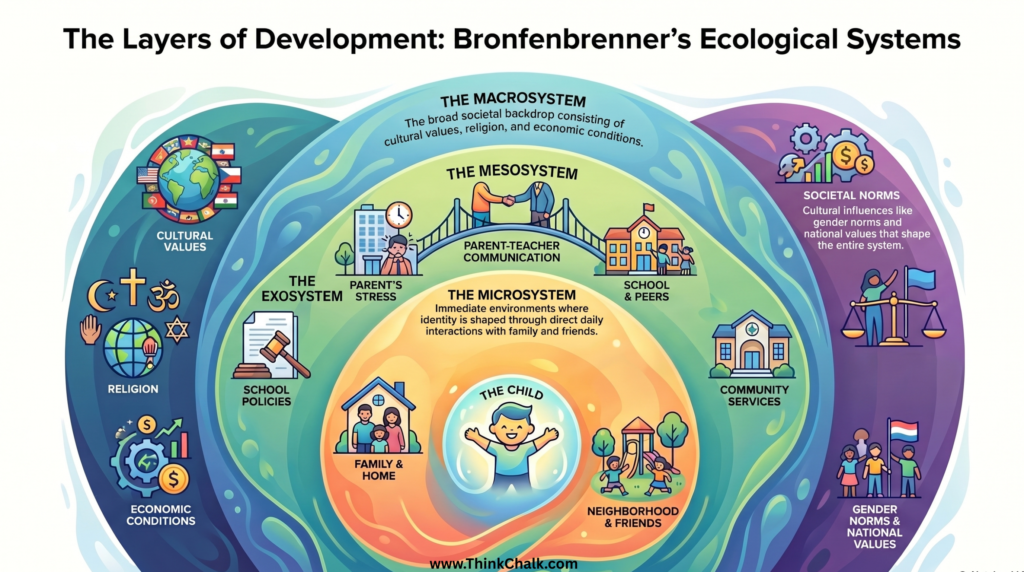
In Pakistani homes and schools, that friction is already under pressure. The authority that parents, teachers, religious figures, and community elders once carried, the kind that made their disagreement genuinely matter to a teenager, has been shifting for some time. This is not a moral failure on anyone’s part. It is a pattern visible in how adolescents across urban Pakistan communicate, seek advice, and decide whom to trust.
AI is not filling a neutral gap in that landscape. It is stepping into a space where real friction used to live and replacing it with unconditional validation.
A 16-year-old in Karachi who processes her beliefs, relationships, and self-worth primarily through a technology that always agrees with her is not just using a tool; she is using it to shape her identity. She is doing the developmental work of adolescence, but without the conditions that work actually requires.
What parents and educators can do
I want to be careful here, because the easy answer and limiting it, taking the phone, is rarely the right one.
If you are a parent, try getting curious before getting restrictive. Ask your teenager not as an interrogation, but with genuine interest, what they actually talk about with their AI. What does it say that you don’t? What does it agree with that you might, with care, gently push back on?
That conversation, however awkward it feels, is exactly the kind of friction that matters.
For educators, the implication runs in a similar direction. The classroom spaces where students have to defend a position, hear a counterargument, and sit with genuine not-knowing are not inefficiencies in the learning process. They are, increasingly, among the few remaining places in a young person’s life where someone pushes back with real care and without an algorithm behind it.
AI can do a great many things. That, it cannot do.
I think about that classroom often. That one hand in the air. The student who said she tried to argue with her AI and it agreed with her anyway. She thought it was funny. She was not wrong. But she had also stumbled onto something real, something most of us are not yet naming.
The question I keep returning to is a simple one: what kind of person do we become when the only voice we keep going back to is one that always, without exception, says yes?