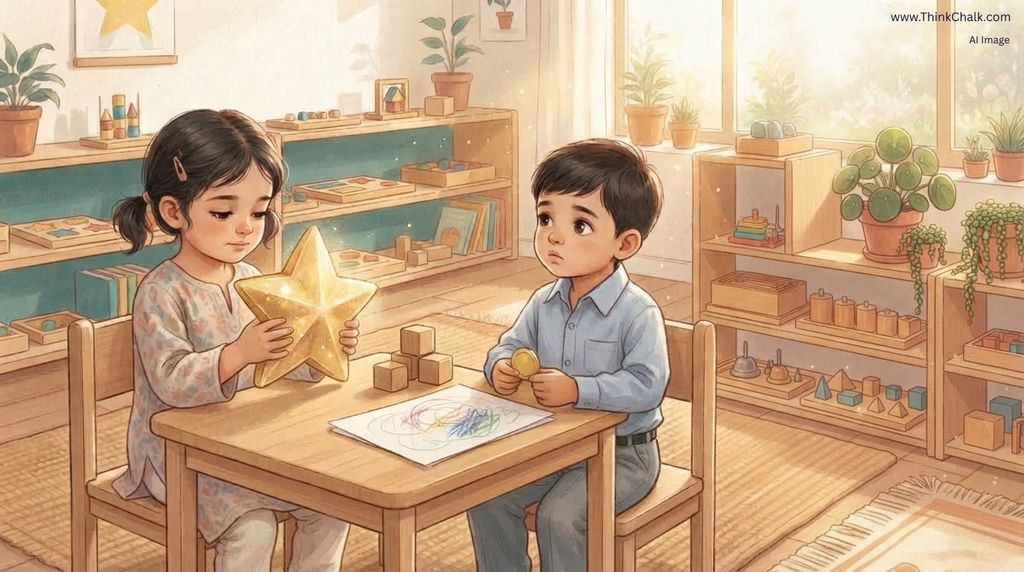
What a school attendance award taught me about motivation in the early years.
My three-and-a-half-year-old came home recently with a question I was not ready for.
“Why did my friend get a bigger reward? Why didn’t I get the same one?”
His school had introduced a full attendance award. Attend 90 to 100 per cent of the time, and the reward is bigger. Attend less, and it is smaller, or there is none.
My son cannot read a percentage. But he understood exactly who got more.
Let Us Be Fair to Rewards
Rewards are not villains, and the research does not say they are. A meta-analysis by Cameron and colleagues concluded that rewards are not generally harmful to motivation. Verbal rewards tended to raise interest, and rewards for tasks children find dull even increased their free-choice interest. The larger Deci, Koestner and Ryan review agrees on one thing: positive feedback strengthened both interest and free-choice behaviour.
So a teacher who says, “You walked in so confidently today,” is on safe ground. A sticker that helps a reluctant three-year-old get through handwashing is not a disaster either. The real question is never “reward or no reward?” It is “what kind, for what, and how?”
Where It Gets Risky
That same Deci review pooled 128 experiments and found that expected, tangible rewards, the “do this and you will get that” kind, significantly weakened intrinsic motivation. Tangible rewards tended to be more harmful for children than for college students. Unexpected rewards did not cause the same damage.
The oldest demonstration is also the most vivid. In Lepper’s 1973 study, preschoolers who loved drawing were promised a certificate for it. As later described in Child Development, only the children who expected and received a reward lost interest afterwards. Those surprised with one, or given none, stayed just as keen. The finding has been replicated with preschool and primary children.
Why does this happen? Self-Determination Theory, developed by Deci and Ryan, says every person has three basic needs: autonomy (I choose this), competence (I am getting better at this), and relatedness (I belong here). A reward that feels controlling quietly chips away at the first one. And Harvard’s Centre on the Developing Child notes that young children are naturally driven by exploration, play, and mastery. They arrive with the motivation we are trying to build.
There is one more risk. Richins and Chaplin found that adults who received material rewards as children were more likely to treat possessions as a measure of success.
Holding It Up Against Karachi
Now place my son’s school scheme next to that research. The reward is expected. It is tangible. It is tiered. And it depends on something a three-year-old does not control.
In Karachi, attendance is rarely a child’s choice. It depends on a cold that travels through the house, a rainy morning when the roads flood, a long drive across the city, a grandparent who needs care. A tiered reward ends up measuring family circumstances and calling it effort.
Our children are also growing up in a world that teaches them to want early. A PwC survey found that 61 per cent of US children aged 7 to 14 say social media makes them want to buy things. Gen Alpha is already learning to want. We should ask whether school is where they should also learn to compare.
I understand the intention. Schools want parents to bring children regularly, and many of us reach for the same sentence at home: “Bas school chalo, inaam milega.” (Just go to school, you’ll get a prize.) It works on Monday. It is the Friday after that that worries me.
What We Can Do
Describe, don’t grade. Instead of “good boy,” try “You put your shoes on all by yourself.” It names the effort without turning the child into a score.
Keep recognition surprising and shared. A class celebration at the end of the term sits far safer with the research than tiered prizes announced in advance.
Answer your child honestly. Something like: “Some days we could not come, and that is okay. You are not less because of it.” At three, that is the reward that matters.
Ask the school with curiosity, not accusation. “What behaviour are we hoping to build with this?” is a question most teachers welcome, and it puts you on the same side of the table.
I am still thinking about how to answer my son properly. But I know what I want him to believe at three: that his worth does not go up or down with the days he could attend. What might early years look like if we measured curiosity, kindness, and persistence, instead of only what is easiest to count?